Starting Your Fashion Photographer Career

Read how one fashion photographer got his start in this profile.

Profile of Chad Boutin

Chad Boutin Photographie
Over 20 years of photography experience; 12 as a commercial and fashion photographer

fashion photographer

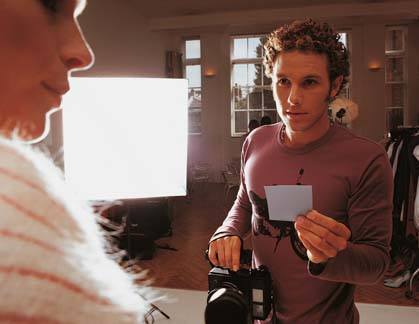
The life of a fashion photographer involves marketing, scheduling, directing, building or painting sets, and—not to be forgotten—taking pictures. For Chad Boutin, an award-winning photographer whose work has appeared in Vogue, it is an art form that delivers in terms of creativity and control.

With over 20 years of industry experience, the last 12 of which have been as a commercial and fashion photographer, Boutin advises others entering this field, "Get your name attached to a style. Clients compensate me for a style, not because I own a camera. My camera plays a minor role in what I do. I direct. I put my style in a scene."

Becoming a Fashion Photographer

Boutin's passion for photography began in high school when he started reading college-level textbooks to learn the technical aspects of his craft. He embarked on his photography career as a photojournalism student in Eugene, Oregon, first at Lane Community College and then the University of Oregon. He learned early on, however, that photojournalism did not offer what he loved most about photography: creating a scene and a style.

As a photojournalist, Boutin "had to be in the right place at the right time to capture an image." Boutin wanted to create images, not just capture them, which meant he needed control to pick locations, select models, set up lighting, and, if necessary, re-shoot until he put his touch on what clients wanted.

Education Advice for Aspiring Fashion Photographers

He advises, "If you are serious about commercial or fashion photography, go to a technical school, art school, or the Brooks Institute." Specialized schools like these offer the technical education a photographer needs, especially in the digital world where so much latitude exists in terms of editing and touching up photos.

Along with technical training, art and photo technical institutes offer placement services. A student becomes "a member and a part of a community for life." Additionally, Boutin strongly recommends that fashion photography students get to know their instructors: "Find that person who inspires you, and take every class they offer. Instructors are people that mold you and impart information to you. If you find one that inspires and challenges you, stick with that person."

Fashion Photography Work Environment

Boutin's studio in Eugene, Oregon, reflects his preferred work environment for fashion photography. He likes to work in open, clean, white studios because they are easier to light, and he can rearrange his gear as needed. In addition, he enjoys shooting on location and often takes advantage of the different scenes and settings the Pacific Northwest has to offer.

Putting in an average of 60 hours per week, Boutin says, "Every day is work." He is doing one of three things each day: shooting, working on post-production or marketing himself to find his next shoot. "My life consists of marketing. That's what it's about." He asserts the unbelievable competition for fashion photographers, remarking that "No one wants to be your friend. No one will share secrets or tell you how they do it." At the start of your career, depending on your locale, expect to work for close to nothing in order to break in to a market.

Finding and Working with Clients

Boutin strives to understand the competition whenever he approaches a new project or client. Most of the time "you're taking a job from somebody else, so you must have a way to approach the client without offending them about the work they've had done so far." He looks for areas to complement and build on, demonstrating his professionalism and desire to be a team player. In some cases, he may decide to continue in the client's current direction but present a path for taking the client's work "to a new level" or for producing results more quickly, efficiently and under budget.

Interpreting the client's needs remains Boutin's toughest challenge as a fashion photographer. In this industry, "You have to stand out somehow. Impress the client with technical merit, stylistic merit, or shock them. Break a rule or taboo. Make them remember you." He's built his portfolio based on these rules, and his list of clients includes Redken, SportHill, Bellissimo Coffee, Coolestshop.com and Avon—to name a few.

For Boutin, his best days as a fashion photographer are sometimes the ones that start out the worst. "If I'm burned out or don't have an idea or am not on-point that day, and I still have the ability to make it happen on the set," that's when "the camera moves for you." That's when you know you've made it.